Sunday, April 3, 2016

Book Review: "Nova" by Samuel Delany


Samuel Delany is not a new name to Science Fiction, nor is "Nova" a recent book. It was first published in 1968, and Delany is associated with other SpecFic greats like Isaac Asimov and Philip K. Dick. He has won multiple awards, all well-deserved, for his creative and insightful depictions of humanity in the future. His works, "Nova" included, often address questions of race and sexuality that at the time were only just beginning to be overtly explored through texts like Ursula K. LeGuin's "The Left Hand of Darkness." As a self-identified African American gay man, Delany uses his personal experiences with minority status in multiple ways to create beautiful, imperfect characters and alien worlds that are all fraught with dangers, both obvious and hidden. 

"Nova" is no exception to this haunted beauty of Delany's, and focuses on character more than action as the plot progresses. This seemed odd to me, since the adventurous setup for the novel had me eating out of the author's hand from the second chapter or so. In this interplanetary saga space ship captain Lorq Von Ray, the only son of a wealthy family in the Pleiades, is convinced that he's found a way to break a rival family's choke hold on Illyrium, the scarce but powerful element that powers everything from space-age musical instruments to space ships. But to overthrow the Red family and end the feud that' been raging between them for generations, he'll have to find a crew that's brave - or desperate - enough to fly through a nova. That's right, Lorq believes Illyrion to be concentrated in the center of an actively collapsing star before it's exploded outwards to spread again across the galaxy. But who can survive the intensity of an imploding star? Lorq has clues, and he and his crew are on their way to finding out whether or not survival and success are both possible. 

Lorq is a fascinating character, the product of interracial marriage and his family's questionable rise to power in a star system far from Earth and the Draco system. He is haunted by childhood memories of Prince and Ruby Red, brother and sister from the highly esteemed and very influential Red family. Prince's bitterness and cruelty, which holds his sister Ruby in thrall, both repulses and fascinates Lorq, as indicated by the violent scar across his face. The result of a violent fight when they were young men, it serves as a reminder to Lorq. The fact that he never had it medically mended never ceased to trouble his mother. 

Others among the crew demonstrate queer quirks of character as well, particularly where identity is concerned. Chief among them are Mouse, the gypsy man who's wandered the earth and now travels the stars, picking up symbols and traits from every group to which he's ever belonged, carrying them on himself like a living record of identity; Katin, a well-educated but directionless young man who has an affinity for moons and a desperate desire to escape the sense of meainglessness that plagues his life; and Lynceos and Idas, two of three triplets from the Outer Colonies, one black as night and one albino, two sides of the same coin that reflect and complete one another. All of this beautiful rainbow of unique individuals reflect a search for something, and hint at their own reasons for following Lorq on what appears to be a hopeless mission from which they will not return, whether because of the nova itself or because of Prince Red's determination to stop them. 

I loved this book, was drawn so deeply into it that it never seemed odd to me that the plot wasn't moving forward very quickly. The characters, particularly how they move back and forth between their memories and their present, are so vivid and fascinating that the mission to find a nova could have failed entirely and I would not have felt cheated by this novel. The mission that Lorq sets them all on is the catalyst for their self-discovery, the crystallization of their identity and the things they learn from one another about themselves, so subtly orchestrated by Delany that the book never feels forced or obvious. 

One of my favorite aspects of the novel was the technology used to pilot the ship. Nearly everyone in the galaxy is outfitted with cybernetic implants that allow them to plug into machines, everything from vacuums to space ships. These connections that blur the line between human and machine are discussed at length so as to give the reader a brief history of how that particular revolution came about, I couldn't help but be reminded of smartphones, of the present-day cybernetic technology that's being developed, and of how drone technology is progressing. And remember, this book was published in 1968! It's a crazy backwards-facing time portal into what one extraordinary man imagined the future might hold for the human race, what it still might be one day. 

If you like classic Science Fiction and want an experience that blends technology with identity and a space-age Moby Dick-type story of obsession and destruction, then you can't beat the intergalactic rivalry and introspection of Samuel Delany's "Nova." It's still in print, and available from your favorite local, independent bookstore. 

Monday, March 21, 2016

An Interview With William Gibson

William Gibson in 2012. Photo by Gilly Youner.

Dear readers, I have a confession to make: I am, in addition to being a SpecFic junkie, a TED junkie. At the gym, on a car trip, on the bus or sitting on my couch in a literary daze after an evening of studying, I have been known to pull up the latest TED talks on everything from writing to wind turbines and just soak in the ideas. Some of them stick, and others don't, but when I happened upon this interview with famous SpecFic author William Gibson, I came out of my literary coma to pay attention.

Famous for his place at the head of third-wave postmodern SciFi, Gibson is the person who coined the term "cyberspace" and jump started the idea of virtual realities with incredible works of science and imagination like "Neuromancer" and "Pattern Recognition." Read the interview to find out some interesting insights about his process and the ideas behind his work! And when you're done, go pick up a few (or all!) of his books at your favorite local, independent bookstore.

Saturday, March 12, 2016

Independent Bookstore Day 2016


My very favorite holiday is Halloween. The only other celebration that comes close to that in my heart is fast approaching this year: Independent Bookstore Day. Every year, indie bookstores across the country partner with publishers, authors, and other entities to bring their supporters exclusive book-related products and exciting events that can't be found anywhere else, but that's just the surface of what Independent Bookstore Day is about.

Brick-and-mortar bookstores survive in a digital age not just because of the products they sell, but because of the community that they provide. Independent bookstores are centers not just of literary thought, but of new ideas, connections to people and resources, and the proliferation of a livelong love of books. At independent bookstores you can talk to a real person, with a real love for and knowledge of books, to find exactly what you're looking for even before you necessarily know what that is. It's one of the things that made me want to be a bookseller in the first place, walking into my neighborhood bookstore and talking with someone for a few minutes, to be handed the exact volume that I needed in my heart. That's an experience that you can't get by browsing through "People who bought this...." lists online, or by limiting yourself to the carefully curated shelves of chain bookstores that have their selections so closely dictated by politics and popularity.

Independent bookstores area community treasures, meccas of learning and exploration, places for children to learn and grow and for everyone to find something that calls to their hearts and minds. And the spirit of that isn't just in the books on the shelves; it's in the people who work there and act as catalysts for that magical experience of finding *just the right book.* Independent Bookstore Day celebrates that and encourages us to stop by our favorite bookstores for exclusive products and opportunities for special books and gifts that are not available anywhere else. Innumerable authors, beginning with Sherman Alexie (who helped found Indies First), will be appearing at their favorite local bookstores for readings, signings, and to promote not just their own books but their favorite books from other authors.

No lie, I look forward to Independent Bookstore Day every year. It does my little bibliophile heart so much good to be reminded that books are not dying; they're flourishing, thanks to independent bookstores and the people who support them. Call or visit your favorite local independent bookstore to see if they're one of the over 400 brick-and-mortar shops nationwide that will be celebrating Independent Bookstore Day this year with fabulous book products and events. And if you love the event, let others know! Word of mouth is part of the wonder of the community that can only be found in independent bookstores.

Friday, March 4, 2016

Story Review: "Atmosphæra Incognita" by Neal Stephenson


In preparation for writing my Master's thesis, I'm getting the opportunity to read a lot of Sci-Fi and SpecFic masterworks. Part of the dilemma I'm running into as someone who wants to spend their academic career studying this area of literature is a lot of pushback claiming that "genre fiction" isn't really worth studying because its only real purpose is entertainment. I can't begin to tell you how much I disagree with that, and if you read either SpecFic or this blog on a regular basis, odds are that you take issue with that claim as well.

Well dear reader, thankfully we're not the only ones. Project Hieroglyph, headed by Arizona State University and Neal Stephenson, among others, is a group of writers and scientists intent on demonstrating to the world how science and science fiction depend on one another. Using cutting-edge science, writers craft stories of near-future events using the technology that we already have as a starting point. Many of these stories and the corresponding essay sources that helped to inspire and inform them are collected in a wonderful book that came out last year, entitled "Hieroglyph: Stories for a Better Future." All of them focus on the beneficial ways that science and science fiction help to support and inspire one another, and are part of the research that I'm doing in preparation for defending my thesis.

The first story in this collection is entitled "Atmosphæra Incognita," by Neal Stephenson. It's the story of the world's first space elevator, from conception to construction to the First Bar in Space at the top. Using information about current engineering technology and creative ways of tackling some of the unknown dangers and complications that a real-life space elevator could create, Stephenson has crafted a story of human ingenuity, practical production and politics, and thoughts about the reality of undertaking such a project. The world in which it takes place is recognizable as our own, despite the incredible undertaking of building a space elevator: people still contract cancer, unknown forces present unresolved problems, and there are "unholy alliances" formed between politicians and corporations. But there are also hints at the "better future" that Project Hieroglyph hopes to inspire: the space elevator is indeed built, homosexual couples deal with everyday questions of location and jobs instead of being constantly terrified by the prospect of hate crimes, and a part of the space elevator itself is left open-ended for some kind of project or development that might be yet to come. The founder of the project doesn't even know what it might be used for somewhere in the future.

Stephenson's image of a space elevator and what it could mean for the founders, the builders, the architects, engineers, and other parties involved in the project seemed pretty accurate to me. It presented a genuine sense of excitement tempered by the enormous amount of risk involved in such a venture. But it preserved the idea that the value of taking such a big leap forward is greater than the value of staying "safe" with the status quo and not pushing our boundaries.

As I continue reading "Hieroglyph" I look forward to my introduction to more new ideas about the technology at our disposal right now, and where it could take us in the very near future. If we were to turn our minds and technology to something like Stephenson's imagined space elevator instead of funny cat videos and iphone games, what else could we accomplish? I'm excited to find out as I continue to work my way through this volume. "Hieroglyph" came out last year and is available now through your favorite local, independent bookstore.

Monday, February 22, 2016

Book Review: "Mink River" by Brian Doyle


Friends have been encouraging me to pick up anything by Brian Doyle literally for years. Having finally followed their excellent advice, I'm kicking myself for having waited so long.

It's no wonder that Brian Doyle's previous publications were poetry. That literary background shows itself clearly in the gorgeous, lyrical prose that takes on not only the glowingly rendered images but even the flow and feel of life on the Pacific coast. The seasons blend into one another, wet and dry and cold and not-so-cold, like the characters' lives. Everyone is connected, if not directly by close interpersonal relationships then at least by a few degrees of separation or simply by virtue of living in the same small town. That's the way things go with small-town living, and Doyle captures it perfectly in his fictional location along the Mink River.

While everyone in the book is connected, and Doyle treats us to all of their perspectives at least briefly (even down to the life of a miscarried fetus), Worried Man and Cedar are most closely identifiable as the novel's main protagonists. They are the center point around which the rest of the characters' lives revolve, and it's no wonder, considering that they make up the local Department of Public Works. According to them, Public Works means everything from keeping the city sewer unclogged to tracking down missing pets to recording stories about the town's history for future generations. Worried Man's personal passion is the concept of time. All of these, they argue as they eat salmonberries and split two beers for lunch, are in the public interest and therefore public works.

A child is injured, a marriage is troubled, a young man is beaten and a young girl rescued. An old man dies, a woman creates, a dream is found and journeys are taken. All of these things happen over the course of the story, but it's how they happen that contains and reveals the true magic behind Doyle's talent with words. The flow of characters' thoughts and observations blend with the way the world moves around them, with how they touch and impact other things and people. Doyle captures this through the use of different languages, forestalling traditional use of punctuation, and jumping into characters' heads to capture their emotions and perspectives firsthand. The resulting depiction of life in a small town is truly a work of art, and accurate in a way that perhaps only a poet can capture.

The element of magical realism at work in this novel recalls the Native American traditions that both the author and characters frequently reference. Not only are nature, animal and ancestral spirits present (sometimes physically, as with a female bear and the various spirit guides who make appearances) but one even becomes a central character. Moses the crow, taught to speak by an elderly nun after he fell from his nest too early, was by far my favorite character. His unique blend of mischief and dedication to those he loves, his blend of defiance, humor, and acceptance made him a completely lovable archetype of the Native American legends of Raven. Of all the characters whom I came to love over the course of the book, which includes pretty much the entire cast in some way or another, Moses is the one I loved the best.

If you're a homesick expat from the Pacific Northwest, or a curious soul from elsewhere, read "Mink River" by Brian Doyle. It's as close to home-on-a-page as I've ever come, and I'm a lifelong resident of the Washington/Oregon coast. You will not regret picking up this book. Currently Brian Doyle has two other novels, "The Plover" (named for the fishing boat in "Mink River") and "Martin Marten", to his name and other books of poetry as well. You can find all of them, which you should do, at your favorite local independent bookstore.

Monday, February 8, 2016

So be it! See to it!


Octavia Butler is one of Speculative Fiction's writers best known for bending, stretching and folding ideas of sex and gender. Works like "Octavia's Brood," "Kindred," and "Fledgling" continue to not only have an impact on academic papers on SpecFic, but to also inspire new collections of stories heavily influenced by her works.

Bitch Media recently publicized this image of the back of one of Butler's notebooks, where we see in its raw passion her commitment to success not only in writing, but in changing the world around her through that work. She was determined to be a great author, but to also pave the way for others who would follow in her footsteps. And indeed, she is not only remembered in literary and cultural circles as one of the best SpecFic writers in living memory but also among the disadvantaged youth of color whom her memorial scholarship helps to attend Clarion writing workshops.

When you hit a wall in your writing, get another rejection notice, or start to wonder how the heck you ever thought you could be someone who makes a difference in the literary world, take page out of Butler's book (no pun intended) and reaffirm your passions on paper. Sometimes even that simple act of seeing your goals in ink can help you hang on for another day, another submissions deadline. And when you're a successful writer, you can share it with others who are still struggling to find their footing in the writing world. So be it! See to it!

Sunday, January 31, 2016

Reading Challenge


Before this year, I have never had to consciously set reading goals for myself. It was always something that I did for both education and pleasure, what I was drawn to in my spare time or, I'll admit it, sometimes as necessary escapism. Let's face it, a paperback is much cheaper than therapy, especially if it comes from your local library!

Now that I've returned to school, I am finding to my horror that I don't have time or energy to read for pleasure like I used to. Even as an undergraduate, I was always able to get some recreational reading done after my homework and as a bookseller, reading was literally my life. But when I spend the majority of your day having to sit and really focus on what I'm reading or writing, and when that material is generally of an academic nature, the last thing my body and mind want to do is sit and focus some more in whatever down time I have!

That being the case, this year I decided to participate for the first time in a group reading challenge. A few friends from across the US have teamed up with me, and we're all committed to reading the list that I posted above. Having a group to encourage my reading is really motivating me to keep broadening my literary horizons, and it reminds me that even when I'm exhausted, reading really is fun! Consciously choosing books that are (mostly) new to me, and seeing what others have selected, has gotten me excited for my 2016 reading in a way that my overworked grad student brain thought might be impossible.

If you want some extra motivation for reading this year, consider doing a reading challenge like this one. If the list I'm using doesn't suit you, consider this one from Book Riot or this one from Better World Books. See bits and pieces that you like from each? Create your own reading list! And do get a group of friends together to take on the reading challenge with you. You'll be surprised at how many of them also want to read more but don't feel they have time or motivation. Your arrangement doesn't have to be formal; you can get together every week for a book club sort of check-in while all reading the same book at once, or you can set up a group online to informally share what you've read, what you thought of it, and what's next on your list whenever you happen to check something off your list. A little bit of reading encouragement goes a long way, and the internet is a great resource for that even when your friends aren't all within book club distance. Make 2016 the year that you re-commit to reading!

Monday, January 25, 2016

The Reading of "Lot 49"


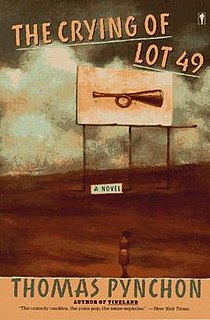
If you've looked into postmodernist literature at all, odds are good that you've run into the name of author Thomas Pynchon. And once you've done that, "The Crying of Lot 49" is bound to come up on your radar in conjunction. It was not the first Pynchon novel that I've read (that would be "Gravity's Rainbow") but it seems to be a popular postmodernist starter because it's quite short: only 152 pages in the paperback edition.

But this strange, unassuming little novel packs a whole lot of punch. The entire thing is one big metaphorical curve ball, made up entirely of intricately interwoven details that are devilishly easy to overlook, resulting more often than not in crossed eyes and a strong urge to pull out your own hair by the fistful. It's the seemingly unimportant, mundane things that the reader finds unite the entire story and pull us deeper down the paranoid rabbit hole that this book is.

While I have read this book multiple times, I wouldn't necessarily say that it's enjoyable. The only people who seem to genuinely like it most of the time are English majors and people who claim to have read it but really bought it just because it looks sophisticated on their bookshelf. Sometimes these people are one and the same. But this select (pseudo-)audience isn't a result of bad writing or pointless metatextual spiraling. On the contrary, all the possibly nonsensical layers are a part of what makes Pynchon's writing so incredibly interesting. When you make a connection, unlock a subtle little secret in the text, you feel like you as a reader have accomplished something nearly as important to the story being written and published was.

Part of why nobody "likes" this and other Pynchon titles much of the time is just that his writing isn't easy to digest. It isn't the sort of paperback that most people curl up with on a rainy afternoon and enjoy over a cup of hot tea. And so unless one is making a deliberate effort to make one's way through this novel, nobody reads "The Crying of Lot 49." I think this is a shame. And half the people with whom I've spoken about it have already decided not to read it without even picking it up, just because its reputation can be intimidating.

The big difference I see here between people who read Pynchon (overwhelmingly English majors and postmodern enthusiasts) and those who don't is that people who work in and around the field of English have been deliberately taught how to read dense and intricate writing like that in "The Crying of Lot 49." We've been painstakingly instructed on how to dissect a text, layer by layer, and it does indeed involve real work instead of just reading the text once and deciding that it "doesn't make any sense."

Perhaps if more people were taught or sought out methods for reading and understanding complex texts like Pynchon's, readers wouldn't be so intimidate of books like "The Crying of Lot 49." If you're interested in taking on a literary challenge like this but don't know where to begin trying to take it apart, here are some quick tips and approaches that I personally find helpful:

1. Keep a running list of characters' names and who they are. Leave some open space underneath your initial entry so that you can expand on their relationships to other characters, because many of the names in "The Crying of Lot 49" contain their own little jokes and ironies. They fade in and out of the larger story without reintroductions.

2. When you start to observe recurring themes or key words and phrases, bookmark them with a sticky note or arrow. Being able to flip back and forth to compare the contexts directly will be immensely helpful!

3. Write down your own thoughts, questions, and interpretations as you encounter them. They needn't be coherent; after all, the text doesn't seem overly concerned with that most of the time. I personally find that actively wild speculation is the best way to keep my brain wide open to receive (and perceive) information from the book, especially when it's a complicated one.

When we make a conscious effort to stretch our brains with books like "The Crying of Lot 49" I honestly believe that we expand our mental horizons and broaden our ways of thinking. You don't have to enjoy a book to get something out of it. In all honesty most of the books that I read for class are not ones that I would choose to read of my own accord had I been let loose and told to pick something that I "liked." But I can honestly say that I have gained some insight, some new perspective, from each of them for which I find good use and am grateful. That's why it's important to read beyond pleasure, to read for more than entertainment. I hope that these basic tips will help to give you the encouragement you need to pick up something that has perhaps intimidated you in the past and give it a try. If you do, please let me know! I'd love to hear about your experience.

Saturday, January 9, 2016

Inspiration From Haruki Murakami


For those of you not familiar with Haruki Murakami, he is a Japanese writer cherished for his lyrical, surreal writing and its insights into the human heart. He has written a large number of books, both novels and short story collections, and his latest volume is entitled "Wind/Pinball." My personal favorite of his work so far (and I have not read everything by him) is "Kafka on the Shore."

No matter which volume of Murakami's that you pick up though, you will find gorgeously worded (and painstakingly translated) insights into what it means to be a person. Not just human, but a real living, feeling person. This time of year, when the fervor of the holidays dies down and the cold grayness of a Pacific Northwest winter can get me down, I like to revisit Murakami's work. It's the perfect way to integrate the soft, cold weather into the dreamscapes of your thinking, and Murakami's work is the perfect material to send you out on that sort of introspective but ultimately positive journey.

If you're interested in seeing what Murakami's writing has to offer you, check out Bustle.com's compilation of "20 Haruki Murakami Quotes to Inspire You." If a particular quote or subject speaks to you, consider picking up the book from which it was pulled. No matter your choice, you're in for a wondrously surrealistic ride that will broaden your mind and make you question your point of view.


Tuesday, December 29, 2015

Best Books of 2015

Nein. A Manifesto

It's hard to believe 2105 is drawing to a close. Of course I find myself saying that every year. Perhaps this time is especially difficult though because it saw the publication of so many fabulous books. NPR's Book Concierge, a great resource for slimming down your reading list to select the best of the best, has put together their yearly list of the Best Books of the Year. Be sure to check it out to make sure you didn't miss anything in your genre of choice! I also enjoy using it as a guide for when I feel like stepping outside my normal reading patterns, and want to make sure that I'm getting something that's already sparked interest or maybe even controversy.

Personally, I've read some pretty fabulous books this year. Among my absolute favorites though have been "The Country of Ice Cream Star" by Sandra Newman (Postapocalyptic SpecFic), "Newt's Emerald" by Garth Nix (YA SpecFic/Alternate History), "Made You Up" by Francesca Zappia (YA), "The Water Knife" by Paolo Bacigalupi (Postapocalyptic SpecFic), and "When We Were Animals" by Joshua Gaylord (SpecFic/Horror). Of these, I have added "The Country of Ice Cream Star" and "When We Were Animals" to my personal library. Even having spent the year working in and studying books though, I know that there are excellent works that I just missed, due to lack of either time or knowledge of them. As always, I love receiving book recommendations so if you would like to see something reviewed here, let me know! I look forward to sharing more books here in the coming year.

Monday, December 21, 2015

Book Review: "Ms. Marvel" by G. Willow Wilson, Adrian Alphona and Jacob Wyatt


Of the wide variety of comics that I've read for class this past fall quarter, superhero comics have by far been my favorites. The sheer variety of modern superhero comics, and how each one of them qualifies as a superhero comic in its own right according to theory on the subject, capture my imagination in ways that Golden Age floppies of Superman and The Fantastic Four never did.

I'm not the only one getting inspired by the potential of superhero comics. Beginning in February of 2014, the superhero character of Ms. Marvel was revamped. The resulting project by Sana Amanat, Stephen Wacker, G. Willow Wilson and Adrian Alphona introduces us to Pakistani-American teenager Kamala Khan as the current reincarnation of this Marvel superhero. This series has been recognized again and again for its presentation of "otherness" in American culture, particularly for a Muslim teenage girl in a situation where she feels like she intrinsically doesn't belong.

The story in this comic is nothing new: girl gains superpowers, there are villains, she is defeated but doesn't give up, and in the end good triumphs over evil. The art is incredible throughout, although appearing in two very different styles. The use of bright colors, with an incredible number of layers to achieve detail and nuance, pull the eye across the page and draw readers into a vivid world that's recognizable as our own, but also just separate enough to make us want to know more. A personal favorite feature of mine was the entertaining slogans and labels written on boxes, products, and advertisements in the background. Be sure to look closely to get a few more laughs!

What makes this comic truly incredible is the *way* in which the contributors accomplish their depiction of being "outside" of the norm. Kamala is like any teenager in that she doesn't feel she belongs. But the struggles that she faces regarding her self-identity and comfort being herself are so many that my heart aches fro her from the very beginning. This is probably most aptly displayed when she first makes her wish to be Ms Marvel, and finds herself transformed from a Middle-Eastern teenager into the leggy, blond, busty image of Captain Marvel with which she was familiar. As the story goes on though, Kamala's appearance even in the persona of Ms. Marvel shifts and changes. Instead of the traditional revealing costume that makes her feel over-exposed, Kamala adopts parts of her own personal blended culture and, as she starts looking more and more like herself, feels comfortable using her powers in her own unique way to be *her* version of Ms. Marvel.

The creators show that she's "just like us" in that she has personal struggles on many levels, which is admirable. But this recognition of Kamala as "just like us" implies an inherent sense of other-ness. It still implies that you have to look beyond some more obvious, even intrinsic traits of hers (like her ethnicity or religion, and the stereotypes and assumptions that get made because of them) to recognize her humanity and how really she has a lot of the same troubles as any teen. But truly, she does not.

I am a middle-class white female. And as a teenager I went through some rough stuff that still dogs me some days even as an adult. But I never had my peers compliment my hijab in an offhand way, or ask if my parents would "honor kill" me if I took it off. Nobody ever asked me to stand back because I smelled like curry. These are all experiences that Kamala has, being Pakistani-American and Muslim. All this is in addition to having to hide her mysterious new superpowers and try to find out what they mean for her. How should she use them? How can she best represent herself and her values, as an individual as well as as a product of her background, in her newfound position as a superhero?

I'm not sure if recognizing and celebrating her otherness is "better" or "worse" than ignoring it in an attempt to be "colorblind." Where does recognizing differences turn into discrimination, and where does lack of acknowledgement become erasure? I don't know the answers to these questions, and maybe there are no hard rules when it comes to the subject. But I do know that "Ms. Marvel" does a (yeah, I'm going to say it) marvelous job of exploring these questions and others. There's a hefty dose of humor in there as well, which helps to balance out the struggles that gnaw at Kamala both in and out of her superhero suit. If you like superhero comics or movies at all, and if you're ready for a painful, beautiful trip through the life of a person who doesn't quite belong anywhere she's found so far, pick up a copy of "Ms. Marvel" soon! You can find the "floppies" in many local comics shops or get the hardcover compilation at your favorite local, independent bookstore.

Wednesday, December 16, 2015

TED-Ed Vernacular Lessons

Image result for TED ED
Readers, I have a confession to make: I am a TED junkie. Studying English (or any other subject, really) is a commitment to that one subject for a very extended period of time, as it should be. But what about when my brain needs a break from literature and analytical writing?

One of my favorite things to do when I reach that breaking point, which happens no matter how much I might love what I'm studying, is to listen to a TED Talk. TED-Ed has so many great series out there about everything from new groundbreaking polymers to cultural explorations to, yes, stories about literature and language. They're perfect for putting on when I go for a run or head to the gym for a little study break and some exercise. I'm still learning, but I get to do it in a different manner, with some subjects that I may not otherwise find myself exposed to.

Lately, as I enjoy a brief winter break from the rigors of my academic program, I'm listening to a great TED-Ed series called "Mysteries of Vernacular." It explores some of the most interesting or unexpected words in the English language and where they come from. My personal favorite so far? The word "odd." The next time you need a break from the holiday music or want something stimulating to listen to while wrapping those gifts, check out the "Mysteries of Vernacular" series from TED-Ed. You'll learn some fascinating bits to bring up over fruitcake and eggnog at your next holiday gathering.

Wednesday, November 25, 2015

Black Girls Matter: A YA Reading List


The dearth of diverse Young Adult books both featuring minority characters and written by minority authors has been especially evident lately. Organizations like We Need Diverse Books and conferences like Sirens Con have sprung up to fight for accurate representation of ALL YA experiences, including mental health and body issues, disability representation, and variety in language, race, ethnicity and culture. This heightened awareness of who we're representing in YA literature and how has led to some great resources for diverse books, including this list from Stackedbooks.org, which gives a great selection of YA books featuring main characters who are black. Take a look, read them through, and pass it along!

Saturday, November 21, 2015

Book Review: "One Hundred Demons" by Lynda Barry


I've been greatly enjoying one class in particular this quarter, entitled "Comics Theory" taught by Eisner Award winner Dr. Susan Kirtley. Recently this class introduced me to artist and writer Lynda Barry, primarily through her work "One Hundred Demons."

I loved this book for a number of reasons, one of which was the origin of the premise. Barry herself explains this in the introduction, so I won't go into it here except to say that it's ingenious and beautiful. Finding inspiration for writing and art projects in other activities is one of the real gifts of begin and artist of any variety. Barry is possibly one of the most versatile writers around right now, and her work displays the myriad ways in which she tackles and attempts to make sense of her childhood experiences. They include questions of identity, race and ethnicity, innocence, coming of age and sexual abuse.

Barry's style particularly in "One Hundred Demons" appeals to me. Its visual aspects, the ways that the collages both tie in the style of her comics panels with bright colors and the way that it serves as almost the opening curtain of the next theatrical short, are at once beautiful and disturbing through how vivid they are. In black and white, or published as a novel, these panels and their stories wouldn't have nearly the same level of impact as they do now. Originally they were published on Salon.com, where the extra printing costs of doing everything in full color weren't an issue. Barry had to fight to have the same color present in the print collection that became "One Hundred Demons" and it's obvious that had she not, this work wouldn't have the impact that it does visually or emotionally.

Another part of this book that I adore is the way that the content is framed by an intro and outro directed at the reader directly from Barry (and her demons). It explains Barry's approach, what started her on the project, and then it invites the reader to try the same process that the author used. This invitation is something that I took seriously, and I've put down a few of my own demons since reading about hers. And like hers, they haven't been the ones I expected. Pick up a copy of Lynda Barry's "One Hundred Demons" at your favorite local independent bookstore and take inspiration from it! It's a beautiful piece of art both visual and literary.

Friday, November 6, 2015

2015 PAMLA Conference

Home

This weekend marks the 113th annual Pacific Ancient and Modern Language Association, or PAMLA, conference in Portland, Oregon. The three-day event takes place in downtown Portland and welcomes scholars from across the United States as well as international figures. Speakers' subjects range from Queerness and Animality to British Literature and Culture and Environment, Ecology and Nature in Italian Literature. The panels offer scholarly discourse and discussion on themes of fiction and nonfiction from an academic viewpoint.

Talks that I'm personally looking forward to attending are Nordic Literature and Culture, Gothic I, Finding Lost Time: Narrative, Nostalgia, Utopia, and two Science Fiction panels. If you're interested in finding out more about PAMLA, including plans for next year's conference and protocol for submitting papers, please check out their website. If you're attending the conference, maybe I'll see you there!

Friday, October 23, 2015

An Interview With Punk Writers


I've recently started working with a group of talented punk writers at Punk Writers. As part of a recent writing project I've written a piece for the upcoming collection "Merely This and Nothing More: Poe Goes Punk." It's a series of stories and poems originally written by Poe, reimagined in various punk genres. As part of that project, I've just done an interview for the PunkWriters website. You can find it here. Enjoy! And if you're a fan of punk genres (steampunk, cyberpunk, splatterpunk, etc.) be sure to keep an ear out not just for "Merely This and Nothing More" but also "Once More Unto the Breach; Shakespeare Goes Punk Vol. II." 

Thursday, October 15, 2015

Book Review: "Storm Front" by Jim Butcher, Dresden Files Book #1


Jim Butcher's Dresden Files are an ongoing series that has achieved a cult status. I've long been suspicious of the urban fantasy genre, since it's a rare thing indeed to find an author who can successfully meld modern living with the legends and power of the world of Faerie. Friends and fellows in the book world have long been suggesting I read Jim Butcher to disprove my stereotype of urban fantasy as too awkwardly meshed or romance-heavy.

I'd say that "Storm Front" is like reading a film noir, much like I described "Shovel Ready" by Adam Sternbergh. But these are two very different novels, not just because of the magical element in Jim Butcher's work; "Storm Front" is classic Bogart where "Shovel Ready" is "Sin City" in the future. Butcher has a much classier, ironic and self-deprecating voice that I immediately adored, and when the plot or certain characters started to disenchant me I stuck with it because of the writing's voice.

Harry Dresden is a modern-day wizard. Yeah, I know what you're thinking. And he thinks it too. It's ridiculous that here in present-day Chicago, he's marketing himself as a practicing wizard. Part of that ridiculousness is that business isn't so hot. But every now and then his associate at the Chicago Police Department brings him in on peculiar cases, and that's how "Storm Front" begins. What follows is an intricately woven tale of murder, mystery and magic with a quirky but lovable good guy who always winds up in the bad situations, an evildoer who is one of those love-to-hate-'em bad guys, and a brief introduction to Harry's dark past and the way that magic interacts with the modern world.

The balance that Butcher strikes between modern-day settings and is well-done in this first volume, focusing on humans who go looking for trouble rather than magical beings that cause havoc. I found this setup much more reasonable than the sort of thing that was played out in "Jackaby" by Raymond William Ritter. The danger that he faces is real, and the snarky, "of course this would happen to me" sort of humor that Dresden adopts as he tracks down a necromancer, avoids the mob and stays out of jail is downright fun to read.

What got to me were some of the social implications that came from the narrative style that's part of that feel of classic film noir. Some of the character tropes were just too spot-on, to the point where I cringed at the implied sexism that went with them. Dresden is the classic down-and-out hero, who retains his manners and a sense of chivalry despite his poor financial circumstances; Murphy is the tough broad with a heart of gold; Susan is the smart, sexy but lacking in self-preservation love interest. I had to keep reminding myself not to get up in arms about how all the women needed rescuing (and only Dresden could do it) and how formulaic relationships, if not the plot, were. And as much as I liked Harry's character, I don't feel like I should have to keep reminding myself that a book isn't sexist. Because if I have to do that, then maybe I'm wrong.

I have so much respect for Jim Butcher as a writer who's founded one of the most iconic fantasy characters of the modern day, and "Storm Front" did help disprove my assumptions about urban fantasy. But because I felt so uncomfortable reading the stereotypical female characters in this first book, I'm not planning on reading any farther into the series. All of the Dresden Files by Jim Butcher can be found at your favorite local, independent bookstore. If you're a long-time Dresden fan, make sure to check there regularly for the next release in the ongoing series!

Saturday, October 3, 2015

The Purpose of Note-Taking

Image result for taking notes

When I was in high school, and  even during my undergrad years, notes served one primary function: to highlight the main points of a lecture or other class material. This helped me to understand what the big takeaway points were in a class, and also helped me to study by pointing to the major points of content with big, florescent green stars and arrows.

I've just completed my first week of classes as a graduate student, and I'm already feeling the pressure of the sheer volume of literature that I have to read for my classes. An English student, I knew that I was in for a lot of reading. That's kind of the point after all. But in an academic atmosphere where I'm reading around a hundred pages of literary theory every couple of days, I've found that note-taking has taken on a new significance and purpose. Now, instead of taking notes solely to highlight the main points of an article or lecture, I'm taking them to remember what I heard and where I heard it.

These sources are important especially in light of the fact that I may need to use them for research material in the near (or distant) future, and being able to glance through an obscenely large file folder of printed articles is much easier when I've scribbled the main points near the title of each one. It also helps to connect material to different classes, underscoring its relevance in literature as a whole regarding the ideas laid out there. Being able to look at an essay by Thomas De Quincey and connect his ideas of absence as meaning with the use of space, textual and artistic, in a graphic novel is something that will be useful to me for the rest of my career. But accessing that information to make those connections is much easier when I can glance through a few pages pull the ones that say something like "meaning in absence" and "the blank space creates meaning."

Note-taking is a real art, to be certain. You have to know yourself as much as the material you're studying, what you want to get out of it and how best to organize it for your future reference, in order to get the most out of it. I'm still regaining my footing as I return to the world of academia, but note-taking is one of the skills that I'm ever so grateful to have retained from my former school years. If you're out of practice, these tips on how to take stellar academic notes from Dartmouth College should help you hone or rediscover your talents.

Monday, September 28, 2015

Banned Books Week 2015


Happy Banned Books Week 2015 everyone! This week in September is set aside by the American Library Association and partners, including independent bookstores. Its purpose is to bring attention to the fact that there are STILL books (and other media) in this country, at this moment, that are banned. Most are for political or religious reasons, like To Kill a Mockingbird and Harry Potter (TKaM supposedly presents offensive racial issues and HP endorses witchcraft. No, I'm not making this up. These are real reasons why these books have been banned in certain United States communities.). Check out your local libraries, independent bookstores, literary foundations and community groups to find out about Banned Books Week events in your area!

Saturday, September 26, 2015

Book Review: "Newt's Emerald" by Garth Nix


With the recent resurgence of Regency romances in YA literature, I've had to be admittedly picky about what I choose to read. Despite their cleverness, intellect and witty repartee, I've never felt particularly drawn to that genre. When you combine it with alternate history, a little bit of magic, mistaken identity and general hilarity though, my interest is definitely piqued. That interest and a history of predominately favorable experiences with his writing led me to pick up "Newt's Emerald," the beginning of a new series by Garth Nix.

Lady Truthful's birthright isn't just her father's extensive property; it's also the great emerald once worn by her dead mother, which is rumored to hold great magical potential. When that emerald is stolen from under her nose, Lady Truthful decides to follow it despite her male relatives' insistence that she stay at home while they undergo various attempts to either regain it or find her a new one. Traveling to London, she finds an unlikely ally in her great aunt and discovers a whole world of subterfuge, magic and conspiracy that draws her in as she searches for her family's emerald.

In order to pursue her line of questioning unmolested, Truthful is forced to take on the persona of a distant relative, a French gentleman bound for the clergy. It is this double life, and the multiple, interwoven cases of mistaken identity that ensue, that make this book such a hilarious, endearing read. As Truthful struggles with both the mystery of her emerald's disappearance and her task of maintaining two distinct identities, her emotions and state of mind are the things that begin to suffer even as she gets closer to the one who may have stolen her emerald. The climax is exciting, imaginative, and endearing all at once and I can't wait for the next installment of this series!

Nix has taken the Napoleonic period and added a thrilling twist of magic to it along with a hefty dash of "The Importance of Being Earnest." It's Regency romance that doesn't take itself too seriously, but recalls the funny little (and not-so-little) foibles in which we all find ourselves embroiled in the pursuit of love, romantic or familial. This is a truly delightful read suitable for a broad range of ages and all genders, especially if you like historical fantasy along the lines of the Temeraire series. "Newt's Emerald" will be released October 13th and can be pre-ordered right now at your favorite local, independent bookstore.