Monday, February 22, 2016

Book Review: "Mink River" by Brian Doyle


Friends have been encouraging me to pick up anything by Brian Doyle literally for years. Having finally followed their excellent advice, I'm kicking myself for having waited so long.

It's no wonder that Brian Doyle's previous publications were poetry. That literary background shows itself clearly in the gorgeous, lyrical prose that takes on not only the glowingly rendered images but even the flow and feel of life on the Pacific coast. The seasons blend into one another, wet and dry and cold and not-so-cold, like the characters' lives. Everyone is connected, if not directly by close interpersonal relationships then at least by a few degrees of separation or simply by virtue of living in the same small town. That's the way things go with small-town living, and Doyle captures it perfectly in his fictional location along the Mink River.

While everyone in the book is connected, and Doyle treats us to all of their perspectives at least briefly (even down to the life of a miscarried fetus), Worried Man and Cedar are most closely identifiable as the novel's main protagonists. They are the center point around which the rest of the characters' lives revolve, and it's no wonder, considering that they make up the local Department of Public Works. According to them, Public Works means everything from keeping the city sewer unclogged to tracking down missing pets to recording stories about the town's history for future generations. Worried Man's personal passion is the concept of time. All of these, they argue as they eat salmonberries and split two beers for lunch, are in the public interest and therefore public works.

A child is injured, a marriage is troubled, a young man is beaten and a young girl rescued. An old man dies, a woman creates, a dream is found and journeys are taken. All of these things happen over the course of the story, but it's how they happen that contains and reveals the true magic behind Doyle's talent with words. The flow of characters' thoughts and observations blend with the way the world moves around them, with how they touch and impact other things and people. Doyle captures this through the use of different languages, forestalling traditional use of punctuation, and jumping into characters' heads to capture their emotions and perspectives firsthand. The resulting depiction of life in a small town is truly a work of art, and accurate in a way that perhaps only a poet can capture.

The element of magical realism at work in this novel recalls the Native American traditions that both the author and characters frequently reference. Not only are nature, animal and ancestral spirits present (sometimes physically, as with a female bear and the various spirit guides who make appearances) but one even becomes a central character. Moses the crow, taught to speak by an elderly nun after he fell from his nest too early, was by far my favorite character. His unique blend of mischief and dedication to those he loves, his blend of defiance, humor, and acceptance made him a completely lovable archetype of the Native American legends of Raven. Of all the characters whom I came to love over the course of the book, which includes pretty much the entire cast in some way or another, Moses is the one I loved the best.

If you're a homesick expat from the Pacific Northwest, or a curious soul from elsewhere, read "Mink River" by Brian Doyle. It's as close to home-on-a-page as I've ever come, and I'm a lifelong resident of the Washington/Oregon coast. You will not regret picking up this book. Currently Brian Doyle has two other novels, "The Plover" (named for the fishing boat in "Mink River") and "Martin Marten", to his name and other books of poetry as well. You can find all of them, which you should do, at your favorite local independent bookstore.

Monday, February 8, 2016

So be it! See to it!


Octavia Butler is one of Speculative Fiction's writers best known for bending, stretching and folding ideas of sex and gender. Works like "Octavia's Brood," "Kindred," and "Fledgling" continue to not only have an impact on academic papers on SpecFic, but to also inspire new collections of stories heavily influenced by her works.

Bitch Media recently publicized this image of the back of one of Butler's notebooks, where we see in its raw passion her commitment to success not only in writing, but in changing the world around her through that work. She was determined to be a great author, but to also pave the way for others who would follow in her footsteps. And indeed, she is not only remembered in literary and cultural circles as one of the best SpecFic writers in living memory but also among the disadvantaged youth of color whom her memorial scholarship helps to attend Clarion writing workshops.

When you hit a wall in your writing, get another rejection notice, or start to wonder how the heck you ever thought you could be someone who makes a difference in the literary world, take page out of Butler's book (no pun intended) and reaffirm your passions on paper. Sometimes even that simple act of seeing your goals in ink can help you hang on for another day, another submissions deadline. And when you're a successful writer, you can share it with others who are still struggling to find their footing in the writing world. So be it! See to it!

Sunday, January 31, 2016

Reading Challenge


Before this year, I have never had to consciously set reading goals for myself. It was always something that I did for both education and pleasure, what I was drawn to in my spare time or, I'll admit it, sometimes as necessary escapism. Let's face it, a paperback is much cheaper than therapy, especially if it comes from your local library!

Now that I've returned to school, I am finding to my horror that I don't have time or energy to read for pleasure like I used to. Even as an undergraduate, I was always able to get some recreational reading done after my homework and as a bookseller, reading was literally my life. But when I spend the majority of your day having to sit and really focus on what I'm reading or writing, and when that material is generally of an academic nature, the last thing my body and mind want to do is sit and focus some more in whatever down time I have!

That being the case, this year I decided to participate for the first time in a group reading challenge. A few friends from across the US have teamed up with me, and we're all committed to reading the list that I posted above. Having a group to encourage my reading is really motivating me to keep broadening my literary horizons, and it reminds me that even when I'm exhausted, reading really is fun! Consciously choosing books that are (mostly) new to me, and seeing what others have selected, has gotten me excited for my 2016 reading in a way that my overworked grad student brain thought might be impossible.

If you want some extra motivation for reading this year, consider doing a reading challenge like this one. If the list I'm using doesn't suit you, consider this one from Book Riot or this one from Better World Books. See bits and pieces that you like from each? Create your own reading list! And do get a group of friends together to take on the reading challenge with you. You'll be surprised at how many of them also want to read more but don't feel they have time or motivation. Your arrangement doesn't have to be formal; you can get together every week for a book club sort of check-in while all reading the same book at once, or you can set up a group online to informally share what you've read, what you thought of it, and what's next on your list whenever you happen to check something off your list. A little bit of reading encouragement goes a long way, and the internet is a great resource for that even when your friends aren't all within book club distance. Make 2016 the year that you re-commit to reading!

Monday, January 25, 2016

The Reading of "Lot 49"


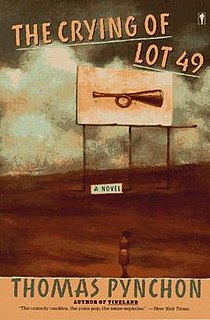
If you've looked into postmodernist literature at all, odds are good that you've run into the name of author Thomas Pynchon. And once you've done that, "The Crying of Lot 49" is bound to come up on your radar in conjunction. It was not the first Pynchon novel that I've read (that would be "Gravity's Rainbow") but it seems to be a popular postmodernist starter because it's quite short: only 152 pages in the paperback edition.

But this strange, unassuming little novel packs a whole lot of punch. The entire thing is one big metaphorical curve ball, made up entirely of intricately interwoven details that are devilishly easy to overlook, resulting more often than not in crossed eyes and a strong urge to pull out your own hair by the fistful. It's the seemingly unimportant, mundane things that the reader finds unite the entire story and pull us deeper down the paranoid rabbit hole that this book is.

While I have read this book multiple times, I wouldn't necessarily say that it's enjoyable. The only people who seem to genuinely like it most of the time are English majors and people who claim to have read it but really bought it just because it looks sophisticated on their bookshelf. Sometimes these people are one and the same. But this select (pseudo-)audience isn't a result of bad writing or pointless metatextual spiraling. On the contrary, all the possibly nonsensical layers are a part of what makes Pynchon's writing so incredibly interesting. When you make a connection, unlock a subtle little secret in the text, you feel like you as a reader have accomplished something nearly as important to the story being written and published was.

Part of why nobody "likes" this and other Pynchon titles much of the time is just that his writing isn't easy to digest. It isn't the sort of paperback that most people curl up with on a rainy afternoon and enjoy over a cup of hot tea. And so unless one is making a deliberate effort to make one's way through this novel, nobody reads "The Crying of Lot 49." I think this is a shame. And half the people with whom I've spoken about it have already decided not to read it without even picking it up, just because its reputation can be intimidating.

The big difference I see here between people who read Pynchon (overwhelmingly English majors and postmodern enthusiasts) and those who don't is that people who work in and around the field of English have been deliberately taught how to read dense and intricate writing like that in "The Crying of Lot 49." We've been painstakingly instructed on how to dissect a text, layer by layer, and it does indeed involve real work instead of just reading the text once and deciding that it "doesn't make any sense."

Perhaps if more people were taught or sought out methods for reading and understanding complex texts like Pynchon's, readers wouldn't be so intimidate of books like "The Crying of Lot 49." If you're interested in taking on a literary challenge like this but don't know where to begin trying to take it apart, here are some quick tips and approaches that I personally find helpful:

1. Keep a running list of characters' names and who they are. Leave some open space underneath your initial entry so that you can expand on their relationships to other characters, because many of the names in "The Crying of Lot 49" contain their own little jokes and ironies. They fade in and out of the larger story without reintroductions.

2. When you start to observe recurring themes or key words and phrases, bookmark them with a sticky note or arrow. Being able to flip back and forth to compare the contexts directly will be immensely helpful!

3. Write down your own thoughts, questions, and interpretations as you encounter them. They needn't be coherent; after all, the text doesn't seem overly concerned with that most of the time. I personally find that actively wild speculation is the best way to keep my brain wide open to receive (and perceive) information from the book, especially when it's a complicated one.

When we make a conscious effort to stretch our brains with books like "The Crying of Lot 49" I honestly believe that we expand our mental horizons and broaden our ways of thinking. You don't have to enjoy a book to get something out of it. In all honesty most of the books that I read for class are not ones that I would choose to read of my own accord had I been let loose and told to pick something that I "liked." But I can honestly say that I have gained some insight, some new perspective, from each of them for which I find good use and am grateful. That's why it's important to read beyond pleasure, to read for more than entertainment. I hope that these basic tips will help to give you the encouragement you need to pick up something that has perhaps intimidated you in the past and give it a try. If you do, please let me know! I'd love to hear about your experience.

Saturday, January 9, 2016

Inspiration From Haruki Murakami


For those of you not familiar with Haruki Murakami, he is a Japanese writer cherished for his lyrical, surreal writing and its insights into the human heart. He has written a large number of books, both novels and short story collections, and his latest volume is entitled "Wind/Pinball." My personal favorite of his work so far (and I have not read everything by him) is "Kafka on the Shore."

No matter which volume of Murakami's that you pick up though, you will find gorgeously worded (and painstakingly translated) insights into what it means to be a person. Not just human, but a real living, feeling person. This time of year, when the fervor of the holidays dies down and the cold grayness of a Pacific Northwest winter can get me down, I like to revisit Murakami's work. It's the perfect way to integrate the soft, cold weather into the dreamscapes of your thinking, and Murakami's work is the perfect material to send you out on that sort of introspective but ultimately positive journey.

If you're interested in seeing what Murakami's writing has to offer you, check out Bustle.com's compilation of "20 Haruki Murakami Quotes to Inspire You." If a particular quote or subject speaks to you, consider picking up the book from which it was pulled. No matter your choice, you're in for a wondrously surrealistic ride that will broaden your mind and make you question your point of view.


Tuesday, December 29, 2015

Best Books of 2015

Nein. A Manifesto

It's hard to believe 2105 is drawing to a close. Of course I find myself saying that every year. Perhaps this time is especially difficult though because it saw the publication of so many fabulous books. NPR's Book Concierge, a great resource for slimming down your reading list to select the best of the best, has put together their yearly list of the Best Books of the Year. Be sure to check it out to make sure you didn't miss anything in your genre of choice! I also enjoy using it as a guide for when I feel like stepping outside my normal reading patterns, and want to make sure that I'm getting something that's already sparked interest or maybe even controversy.

Personally, I've read some pretty fabulous books this year. Among my absolute favorites though have been "The Country of Ice Cream Star" by Sandra Newman (Postapocalyptic SpecFic), "Newt's Emerald" by Garth Nix (YA SpecFic/Alternate History), "Made You Up" by Francesca Zappia (YA), "The Water Knife" by Paolo Bacigalupi (Postapocalyptic SpecFic), and "When We Were Animals" by Joshua Gaylord (SpecFic/Horror). Of these, I have added "The Country of Ice Cream Star" and "When We Were Animals" to my personal library. Even having spent the year working in and studying books though, I know that there are excellent works that I just missed, due to lack of either time or knowledge of them. As always, I love receiving book recommendations so if you would like to see something reviewed here, let me know! I look forward to sharing more books here in the coming year.

Monday, December 21, 2015

Book Review: "Ms. Marvel" by G. Willow Wilson, Adrian Alphona and Jacob Wyatt


Of the wide variety of comics that I've read for class this past fall quarter, superhero comics have by far been my favorites. The sheer variety of modern superhero comics, and how each one of them qualifies as a superhero comic in its own right according to theory on the subject, capture my imagination in ways that Golden Age floppies of Superman and The Fantastic Four never did.

I'm not the only one getting inspired by the potential of superhero comics. Beginning in February of 2014, the superhero character of Ms. Marvel was revamped. The resulting project by Sana Amanat, Stephen Wacker, G. Willow Wilson and Adrian Alphona introduces us to Pakistani-American teenager Kamala Khan as the current reincarnation of this Marvel superhero. This series has been recognized again and again for its presentation of "otherness" in American culture, particularly for a Muslim teenage girl in a situation where she feels like she intrinsically doesn't belong.

The story in this comic is nothing new: girl gains superpowers, there are villains, she is defeated but doesn't give up, and in the end good triumphs over evil. The art is incredible throughout, although appearing in two very different styles. The use of bright colors, with an incredible number of layers to achieve detail and nuance, pull the eye across the page and draw readers into a vivid world that's recognizable as our own, but also just separate enough to make us want to know more. A personal favorite feature of mine was the entertaining slogans and labels written on boxes, products, and advertisements in the background. Be sure to look closely to get a few more laughs!

What makes this comic truly incredible is the *way* in which the contributors accomplish their depiction of being "outside" of the norm. Kamala is like any teenager in that she doesn't feel she belongs. But the struggles that she faces regarding her self-identity and comfort being herself are so many that my heart aches fro her from the very beginning. This is probably most aptly displayed when she first makes her wish to be Ms Marvel, and finds herself transformed from a Middle-Eastern teenager into the leggy, blond, busty image of Captain Marvel with which she was familiar. As the story goes on though, Kamala's appearance even in the persona of Ms. Marvel shifts and changes. Instead of the traditional revealing costume that makes her feel over-exposed, Kamala adopts parts of her own personal blended culture and, as she starts looking more and more like herself, feels comfortable using her powers in her own unique way to be *her* version of Ms. Marvel.

The creators show that she's "just like us" in that she has personal struggles on many levels, which is admirable. But this recognition of Kamala as "just like us" implies an inherent sense of other-ness. It still implies that you have to look beyond some more obvious, even intrinsic traits of hers (like her ethnicity or religion, and the stereotypes and assumptions that get made because of them) to recognize her humanity and how really she has a lot of the same troubles as any teen. But truly, she does not.

I am a middle-class white female. And as a teenager I went through some rough stuff that still dogs me some days even as an adult. But I never had my peers compliment my hijab in an offhand way, or ask if my parents would "honor kill" me if I took it off. Nobody ever asked me to stand back because I smelled like curry. These are all experiences that Kamala has, being Pakistani-American and Muslim. All this is in addition to having to hide her mysterious new superpowers and try to find out what they mean for her. How should she use them? How can she best represent herself and her values, as an individual as well as as a product of her background, in her newfound position as a superhero?

I'm not sure if recognizing and celebrating her otherness is "better" or "worse" than ignoring it in an attempt to be "colorblind." Where does recognizing differences turn into discrimination, and where does lack of acknowledgement become erasure? I don't know the answers to these questions, and maybe there are no hard rules when it comes to the subject. But I do know that "Ms. Marvel" does a (yeah, I'm going to say it) marvelous job of exploring these questions and others. There's a hefty dose of humor in there as well, which helps to balance out the struggles that gnaw at Kamala both in and out of her superhero suit. If you like superhero comics or movies at all, and if you're ready for a painful, beautiful trip through the life of a person who doesn't quite belong anywhere she's found so far, pick up a copy of "Ms. Marvel" soon! You can find the "floppies" in many local comics shops or get the hardcover compilation at your favorite local, independent bookstore.